Have you ever watched someone make THOUSANDS of dollars in just one day from options trading & wondered how they did it? Maybe you’ve heard stories about regular people turning small amounts of money into life-changing profits. Well, you’re not alone in your curiosity! Options trading might seem like rocket science, but it’s actually something anyone can learn with the right guidance & patience.
Think of options trading like buying insurance for your car, but instead of protecting against accidents, you’re making smart bets on which way stock prices will move. The beauty of options is that you don’t need to be wealthy to start – you can begin with just a few hundred dollars & still see meaningful returns. Unlike buying actual stocks where you need thousands to see real profits, options let you control expensive stocks for just pennies on the dollar.
In this article, we’ll break down everything you need to know about options trading in simple terms that even your younger sibling could understand. We’ll explore proven strategies that have helped countless beginners grow their money, learn from real examples that show exactly how these trades work, & discover the SECRET techniques that successful traders use every single day. By the end of this guide, you’ll have a clear roadmap to start your own options trading journey safely & profitably.
Understanding Options: Your Gateway to POWERFUL Profits
Let’s start with the basics because understanding what options actually ARE is crucial before diving into strategies. An option is simply a contract that gives you the RIGHT (but not the obligation) to buy or sell a stock at a specific price within a certain timeframe. It’s like having a coupon that lets you buy something at a set price, even if the actual price goes up later.
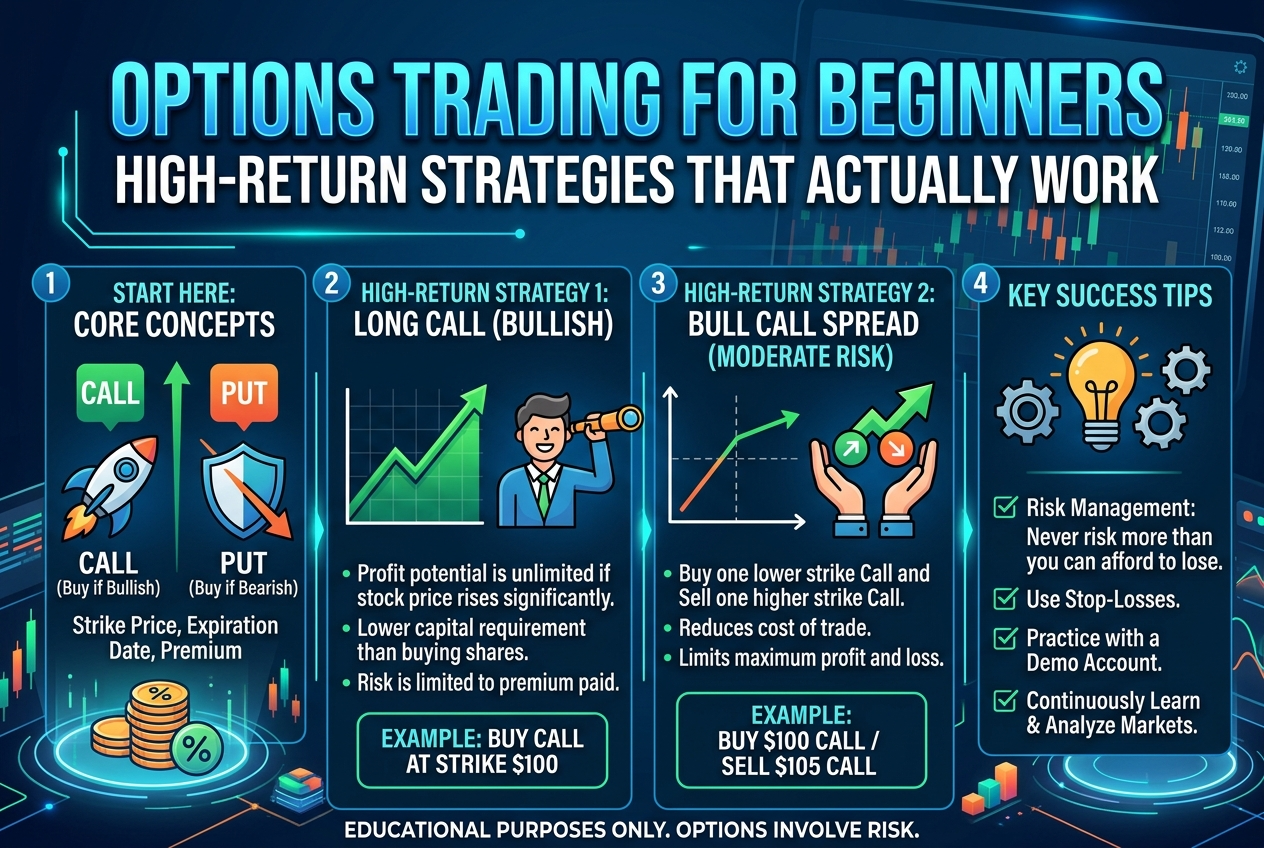
There are two main types of options: calls & puts. A call option is like betting that a stock’s price will go UP. If you think Apple stock will rise from $150 to $160, you might buy a call option. A put option is the opposite – it’s betting that a stock’s price will go DOWN. If you believe Netflix will drop from $400 to $350, you’d consider buying a put option.
What makes options so EXCITING is something called leverage. This means you can control 100 shares of expensive stock for just a fraction of what it would cost to buy those shares outright. For example, instead of paying $15,000 to buy 100 Apple shares, you might pay just $500 for a call option that controls those same 100 shares. If Apple goes up by $10, those actual shares would make you $1,000 profit – but your $500 option might become worth $2,000 or more!
However, here’s the catch that many beginners don’t understand at first: options have expiration dates. Unlike stocks that you can hold forever, options disappear on a specific date. This time limit is both a blessing & a curse – it creates opportunities for HUGE gains but also means you can lose your entire investment if you’re wrong about the timing.
The Covered Call Strategy: Your First Step to Consistent Income
The covered call strategy is like the training wheels of options trading – it’s SAFE, profitable, & perfect for beginners who want to dip their toes in the water. This strategy works best when you already own stocks that you’re comfortable keeping for a while. The basic idea is to sell call options on stocks you own, collecting immediate cash while potentially selling your shares at a higher price.
Here’s how it works in simple terms: let’s say you own 100 shares of Microsoft that you bought at $300 each. The stock is currently trading at $310, & you think it might stay around this level or only go up slightly over the next month. You can sell a call option with a strike price of $320 for maybe $200. This means someone pays you $200 right now for the right to buy your Microsoft shares at $320 anytime in the next month.
What happens next depends on Microsoft’s price when the option expires. If Microsoft stays below $320, you keep your shares AND the $200 you collected – that’s FREE money! If Microsoft goes above $320, you’ll have to sell your shares at $320, but you still keep the $200 plus you make a profit on your original shares ($320 – $300 = $20 per share profit).
The BEAUTIFUL thing about covered calls is that you make money in multiple scenarios. You win if the stock stays flat, goes up a little, or even goes down slightly. The only time you might feel bad is if the stock ROCKETS up way past your strike price, but even then, you still made money! Many successful traders use this strategy to generate an extra 1-2% income every month on their stock holdings, which adds up to substantial returns over time.
The Cash-Secured Put: Getting Paid While You Wait
The cash-secured put strategy is like getting paid to stand in line to buy something you want at a discount. This approach works perfectly when you’ve been wanting to buy a particular stock but think the current price is too high. Instead of just waiting & hoping for a better price, you can actually get PAID while you wait!
Here’s the magic behind this strategy: you sell a put option on a stock you’d love to own, but only at a lower price than where it’s currently trading. Let’s say Disney stock is trading at $120, but you think it’s worth buying at $110. Instead of placing a regular buy order at $110 & waiting, you sell a put option with a $110 strike price & collect immediate cash.
For example, you might collect $300 for selling this Disney put option. Now you’re in a win-win situation! If Disney stays above $110, you keep the entire $300 & can repeat this strategy next month. If Disney drops to $110 or below, you’ll be assigned the shares at $110, but you’ve already collected $300, so your actual cost is only $107 per share – an even BETTER deal than you originally wanted!
The key to success with cash-secured puts is having enough money in your account to actually buy the shares if you get assigned. That’s why it’s called “cash-secured” – you’re not playing with borrowed money or taking excessive risks. This strategy works especially well during volatile markets when option prices are higher, meaning you collect more cash for the same risk.
Many smart investors use this approach to build positions in quality stocks at below-market prices. Think of it as getting a DISCOUNT coupon that pays you to hold it! The worst case scenario is that you end up owning a stock you wanted at a price you were comfortable paying, plus you got paid extra for the privilege.
The Long Call Strategy: Maximum Profit Potential for Trending Stocks
The long call strategy is where the REAL excitement happens in options trading. This is what most people think of when they hear about options – the strategy that can turn small amounts of money into massive profits when you’re right about a stock’s direction. While it’s riskier than the previous strategies, the profit potential is virtually unlimited when you catch a strong upward move.
Buying call options is straightforward: you pay a premium upfront for the right to buy shares at a specific price before a certain date. The trick is choosing the right stocks, strike prices, & expiration dates to maximize your chances of success. Look for stocks that are showing clear upward trends, have upcoming events that could boost their price (like earnings announcements or product launches), or are in industries that are gaining momentum.
Let’s walk through a real example to show the POWER of this strategy. Imagine Tesla is trading at $200 & you believe it’s going to break out to new highs based on strong delivery numbers coming next week. Instead of buying 100 shares for $20,000, you buy a call option with a $210 strike price expiring in two weeks for $500. If Tesla jumps to $240 after the delivery announcement, your option would be worth at least $3,000 – that’s a 500% gain!
However, timing is absolutely critical with long calls. Unlike stocks where you can wait years for your investment to work out, options have that dreaded expiration date. This means you need to be right about both the direction AND the timing of the move. Many beginners make the mistake of buying options that expire too soon or are too far out of the money (strike price too high). A good rule of thumb is to give yourself at least 30-45 days until expiration & choose strike prices that are within 5-10% of the current stock price.
The key to SUCCESS with long calls is position sizing & risk management. Never risk more than you can afford to lose completely, because options can & do expire worthless. Many profitable traders risk only 1-2% of their total account on any single options trade, allowing them to be wrong multiple times while still staying in the game for the big winners that make it all worthwhile.
Risk Management: The Secret Sauce That Separates Winners from Losers
Risk management isn’t the most exciting part of options trading, but it’s absolutely the MOST important skill you’ll ever learn. The difference between traders who make consistent profits & those who blow up their accounts almost always comes down to how well they manage risk. Think of risk management like wearing a seatbelt – it might not be fun or glamorous, but it can save your life when things go wrong.
The first rule of options risk management is never risk more than you can afford to lose on any single trade. This might sound obvious, but you’d be surprised how many beginners violate this rule when they get excited about a “sure thing” trade. A common guideline is to risk no more than 2-5% of your total trading account on any individual options position. This means if you have $10,000 to trade with, you shouldn’t risk more than $200-500 on any single trade.
Position sizing becomes even more critical when you realize that options can lose value quickly due to time decay. Unlike stocks that can recover given enough time, options lose value every day as they approach expiration. This is why SUCCESSFUL traders often close winning positions early rather than holding until expiration. If you’re up 50-100% on an options trade, it’s often smart to take profits rather than getting greedy & risking it all for potentially larger gains.
Another crucial aspect of risk management is diversification across different strategies & timeframes. Don’t put all your money into long calls or puts – mix in some covered calls & cash-secured puts to create steady income that can offset losses from your more speculative trades. Also, avoid the temptation to “double down” on losing positions by buying more options of the same type. When a trade goes against you, it’s usually better to cut your losses & move on to the next opportunity rather than throwing good money after bad.
Taking Action: Your Next Steps to Options Trading Success
Now that you understand the fundamental strategies & risk management principles, you’re probably wondering how to actually get started with REAL money on the line. The good news is that most major brokers now offer options trading with user-friendly platforms that make it easier than ever for beginners to start safely. However, before you dive in, there are several crucial steps you should take to set yourself up for long-term success.
First, spend time with paper trading or virtual trading platforms to practice these strategies without risking actual money. Most brokers offer paper trading accounts that let you trade with fake money in real market conditions. This is your chance to make mistakes & learn without financial consequences. Practice each strategy we’ve discussed until you feel comfortable with the mechanics & can consistently make profitable trades in simulation.
Next, start small when you transition to real money trading. Even if you have $50,000 available, begin with just $2,000-5,000 until you prove to yourself that you can generate consistent profits. The psychological pressure of trading real money is completely different from paper trading, & many strategies that worked perfectly in simulation can fall apart when emotions get involved. Starting small gives you room to make mistakes & learn from them without devastating your financial future.
Education should be an ongoing priority throughout your options trading journey. The market is constantly evolving, & new opportunities emerge regularly for those who stay informed. Follow successful options traders on social media, read books about advanced strategies, & consider joining online communities where you can learn from other traders’ experiences. Remember, every expert was once a beginner who chose to keep learning & improving rather than giving up after early setbacks.
Finally, be patient & realistic about your expectations. While it’s true that options can generate spectacular returns, consistent profitability takes time to develop. Focus on learning proper risk management & mastering one strategy at a time rather than trying to get rich quick with complex trades you don’t fully understand. The traders who make millions didn’t do it overnight – they built their skills systematically over months & years of disciplined practice. Your options trading journey starts with a single trade, but your SUCCESS depends on the thousands of smart decisions you make along the way.